Looking Back and Passing On
As dancers our bodies carry the history of the things we have made, even when we think we have left them behind.
In this blog I reflect on ageing, bodily memory and the value of looking backwards. I am thinking about the many layers of artistic input dancers bring to the work they collaborate on. What happens when that work passes into other bodies? How can art connect across generations of artists? In our constant pursuit of the new, what might we be overlooking by not looking back?
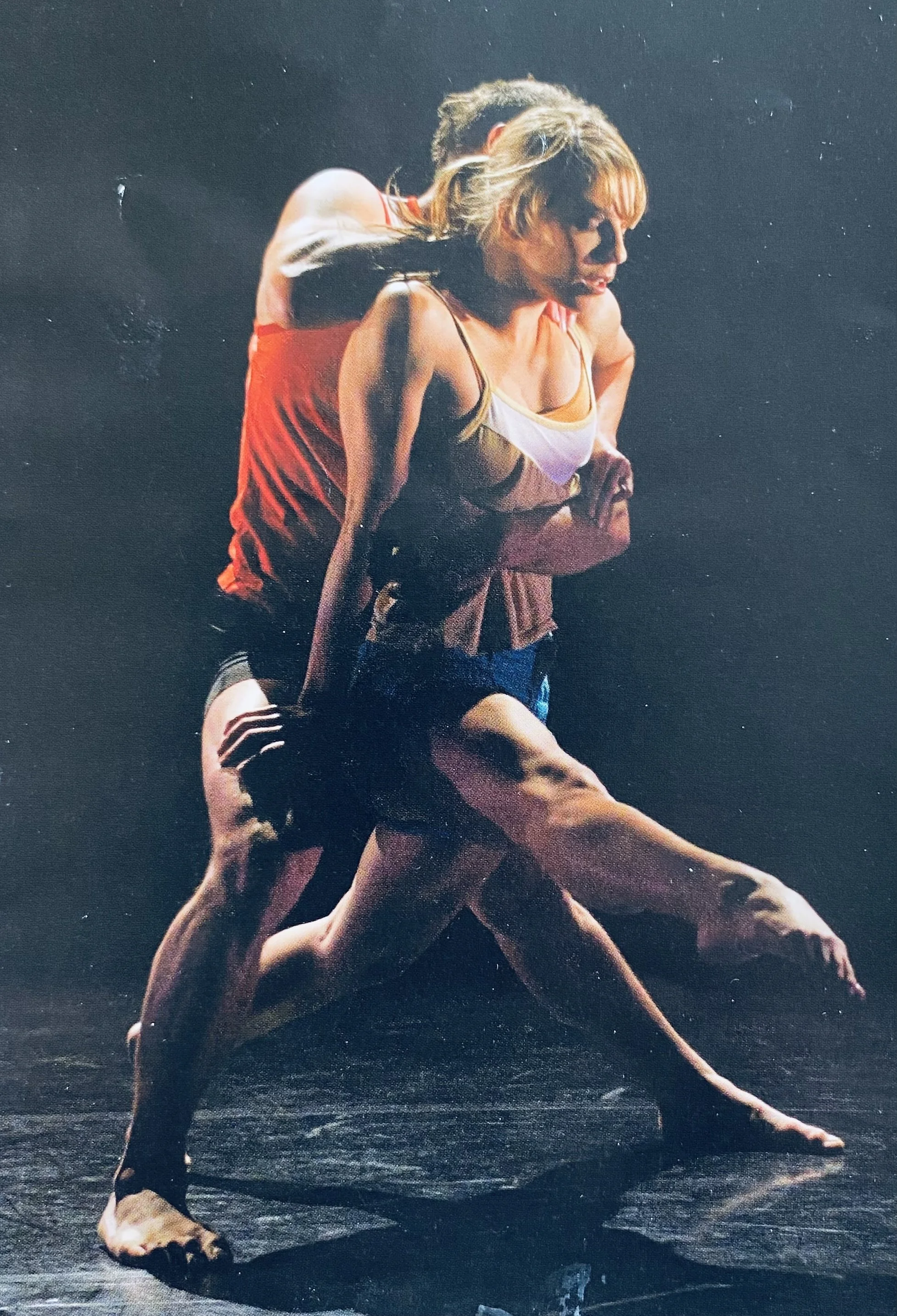
Me and Lee Clayden, E2 7SD, The Place Prize 2004, Photographer unknown.
Looking back
E2 7SD was a 15-minute duet I performed with Lee Clayden in 2004, choreographed by Rafael Bonachela for The Place Prize. Twenty-two years later, it has been remounted on Sydney Dance Company, where Raf is Artistic Director.
Seeing an extract of us dancing it again, and having people post their memories of being in the audience, has allowed me to reflect on the work, the passing of time and passing on of knowledge.
Looking at the younger me dancing it feels like a different person from a former life. It's nice to take a moment to savour the past. The things that made us who we are, shifted and changed us, enabled us to grow. For me, so much of that history is in the body.
At 47, I’m thinking quite a lot about what my performing body does now. How that extraordinary, athletic, virtuosic, sensitive, articulate body in the video went on to grow and birth three children and experience another twenty-two years of life and performing.
Child number 1 is leaving the nest now. Maybe that’s part of my present nostalgia. And maybe getting older inevitably makes you think about what you leave behind and pass on to future generations.
I try to celebrate that younger body rather than mourn it. Deep in my cells, I have a muscle memory that lives in and through me, and in another twenty years, if I live that long, my body will hold many more experiences.
With this particular memory, there is a positive glow around it. The difficulties felt like healthy challenges and I have a strong sense of pride and respect for my younger self.
Steely focus
I don’t remember thinking about winning. We wanted to make the best 15-minute piece we could. At some point we realised we had a strong enough piece to be a contender, but that wasn’t how it began.
Maybe it was a chance for all of us to prove ourselves. At 24, I had been a year out of Rambert Dance Company and was paving my way as a London-based freelance dancer, full of passion and ambition, wanting to push the edges of what my artform, and I, could do. Raf was just leaving Rambert after many years as a dancer and choreographer within the company.
We were all living as independent artists in vibrant East London, at a crossroads where the future felt unknown but exciting. We wanted the work to encapsulate that energy. Raf knew his movement vocabulary and style and I’d worked with him for years. Lee brought something exciting to the mix and together we were really well matched. With distance, I can appreciate this was an ability to move between liquidity and explosive qualities, It was in our bodies, our physiology, our training.
I remember how gentle and sensitively attuned Lee and I were with each other. We had to constantly switch registers. One second I would put all my body weight into shifting him, and he would use that as a springboard to propel himself; the next I would acquiesce, allowing him to throw me whilst containing the energy flying through me. It demanded absolute, steely focus.
We moved quickly between the extraordinary and the ordinary. I remember the late John Ashford commenting on how exciting he found it to watch us come out of something incredibly difficult and then drop it, walk across the stage and look at the audience as if nothing had happened. That has stayed with me as a power to hold on to. A form of ‘dropping the act’ that is used in many performative contexts.
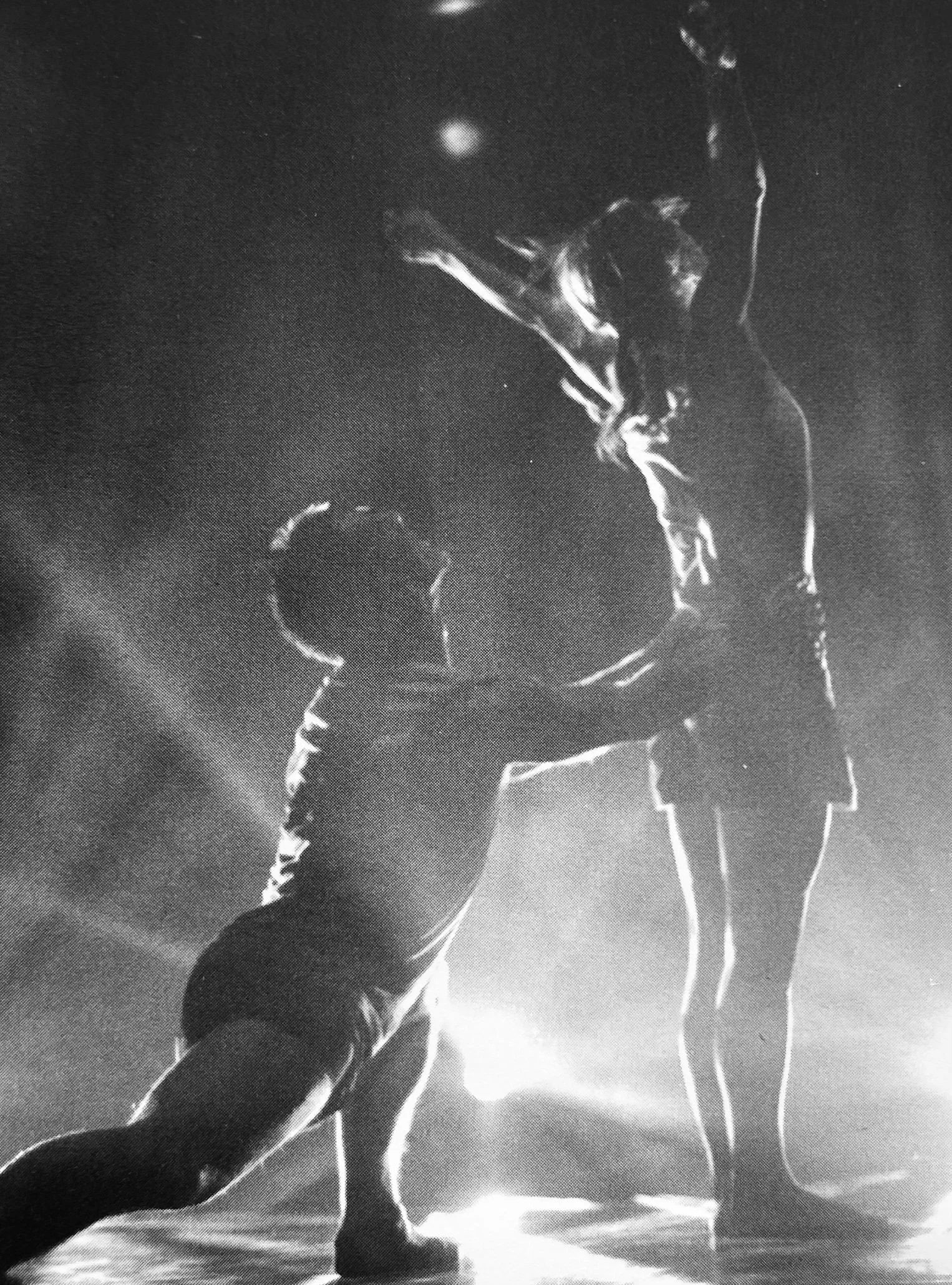
Me and Lee Clayden, E2 7SD, The Place Prize 2004, Photographer unknown.
What arrived in the room
Often it's the limitations, exhaustion, accidents and practical realities that shape the work.
We were all exhausted working on other things at the time, and sometimes we could only grab a couple hours together to make material. Raf had to work with the bodies and energy that arrived in the room.
Looking back, I’m not sure we would have made the same piece if everybody had walked into the studio each day with full energy. The first half is incredibly tender- intimate embraces, playing with flesh and contact. In performance it was like getting a dose of oxytocin for when the piece ramps itself up and becomes a fight till the final collapse.
Because my memories are so inside my body, I often forget the extraordinary sound composition by Oswaldo Maciá. Oswaldo gave us little microphones to carry around for a month. We recorded hours of our lives- intimate moments of reflection, joy, sadness, alone or out with friends. There is a poem in there too.
He took our precious material and wove fragments of it into the score, composing the piece like an installation, with sounds and voices channelled across different speakers, shifting attention around the auditorium. It’s a beautiful composition, alongside what was a powerful lighting design by Lee Curran.
Keep your head down
There was other stuff going on, as always. Our DVD players were stolen from the tech room, rehearsal CDs went missing, non-audience members caught sneaking in at the end to place votes in the daily £1000 audience prize competition…! We tried to keep our heads down, keep a low profile and stay focused.
I remember beautiful things like Rosemary Butcher standing backstage quietly with her dancer every night, side by side, almost meditating as they waited for their turn. New Art Club getting on with their thing, being kind, fun and respectful. And I remember the exhaustion and hard work, how much we enjoyed it, how united we were as a team and how supported we felt by Raf.
These things feel part of the artistic inheritance, as we absorb from others their ways of behaving, concentrating, preparing, navigating pressure and supporting each other. When its generous and healthy it’s a wonderful community to be part of.
Whose movement is it anyway?
I also remember walking out to the bar behind a choreographer I had previously worked with and overhearing them comment that they had noticed some “familiar moves” in the duet- traces, perhaps, of the work we had made together.
Looking back, I can understand the observation. Of course there were traces. We (Lee and I) were the common denominators- the same two young dancers, bringing the same bodies, training, instincts, imagination and physical histories into another creative process.
I’m genuinely grateful to have overheard that conversation at that particular stepping stone in my career. It helped clarify something for me about collaboration and gave momentum to my desire to pave my own way with Probe.
I have always felt quite clear about what I bring to a collaborative process. I bring my body, everything it has learnt and everything it innately is at that moment in time, and immerse it in a project. I try my best to mould and shape it towards the desires of the choreographer, digging deeper into that understanding through performance and putting all the relevant parts of my heart and soul into the role or performative game appointed to me.
I have heard choreographers say that past collaborators have gone on to make independent work that resembles their work, and I find that problematic. It raises questions for me about where authorship sits when a dancer generates material in response to a choreographic idea. The choreographer shapes and frames it within a larger work, and over time that movement becomes part of the language associated with the choreographer, perhaps then passed on to future generations of dancers. That original dancer carries the experience in their body and subconscious. If material was initially generated through their body, it seems inevitable that elements of it might resurface in other creative processes as we carry it with us. And the art lives on… through us.
The question also feels pertinent when pieces are remounted. As well as preserving choreography, remounting can reveal something about the layers of people, bodies and collaborations that made it in the first place.
I was lucky enough to remount E2 7SD on Rambert2 a few years ago and had a beautifully reciprocal experience working with three casts of young dancers, passing on what I remembered while encouraging them to find their own journey through the work rather than trying to replicate ours.
Passing it on
I remember being a young performer when work was remounted on me. There was something significant about taking on roles that had belonged to seminal performers who went before me. Sometimes they would come into the studio and impart their knowledge. It felt like a gift to receive something that had existed in somebody else’s body before mine.
That legacy does something to your artistry. I found trying to embody the language and movement patterns of other bodies exciting. It gave me the freedom to play outside my own limitations and added new movement pathways to my subconscious.
Now I find myself on the other side of that exchange, I understand the responsibility and value of passing that knowledge on.
Recently, I was messaged by the dancer currently performing E2 7SD with Sydney Dance Company. I had taught her previously and she trained, like me, at Rambert School, so there was already a connection between us. I was thrilled she had reached out to share her experience of dancing it, and to hear that studying the duet from us on film had been impactful.
There is something moving about a piece travelling through generations of dancers, accumulating new bodies, experiences and interpretations along the way. With such an emphasis on productivity and new invention, perhaps we sometimes underestimate what can be discovered by looking backwards. Returning to existing work needn’t be stagnant. An old piece can produce a new commentary on where we are now.
The work never remains the same.
People change it.
Time changes it.
The world around us changes it.
It's been nice to stop for a moment, be grateful and give value to history.
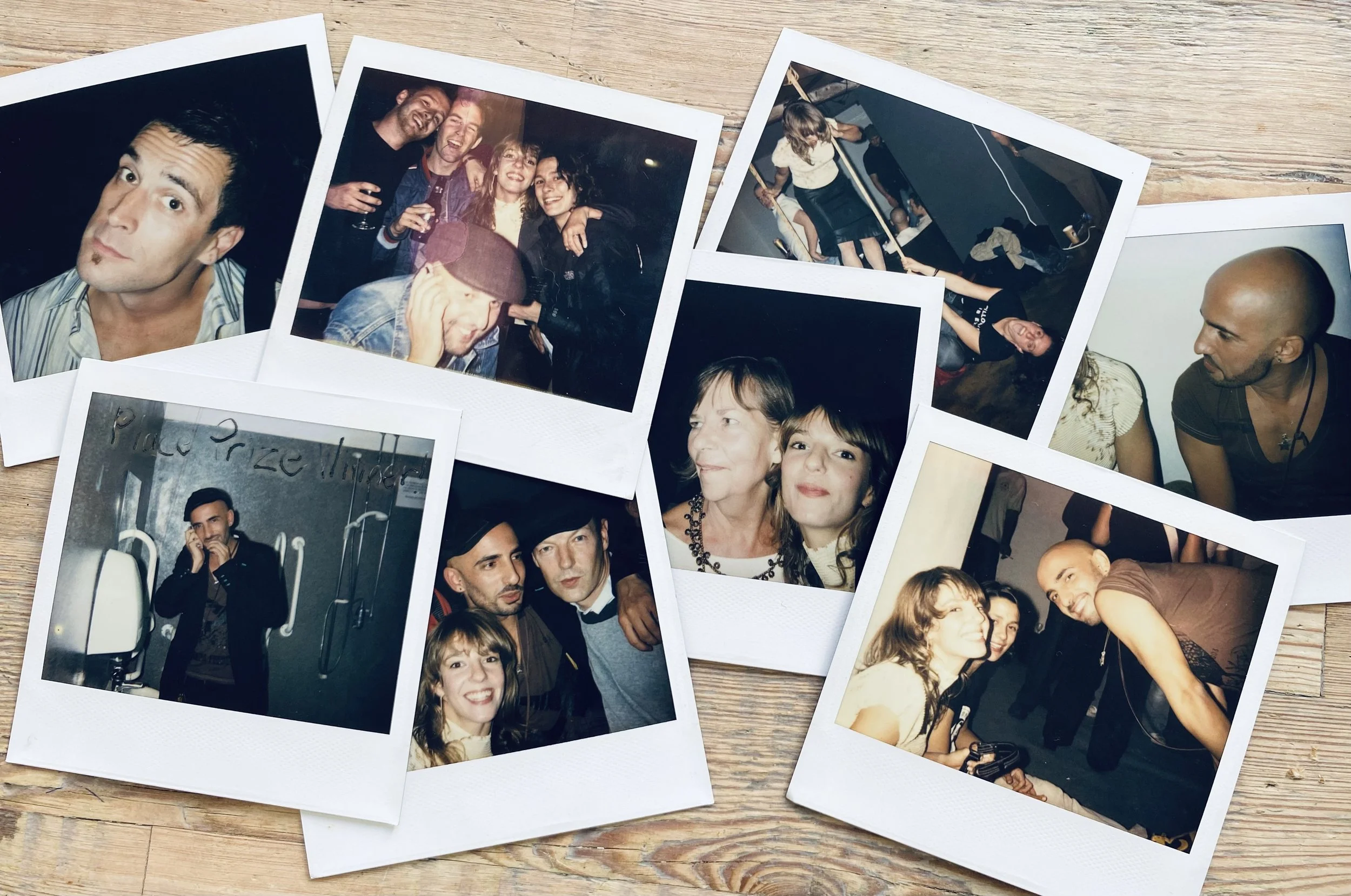
My polaroids from celebrating our win with friends and colleagues: Lee, Theo, Jacob, myself, Rachel, Alex, Raf, Alan, Val, Anny
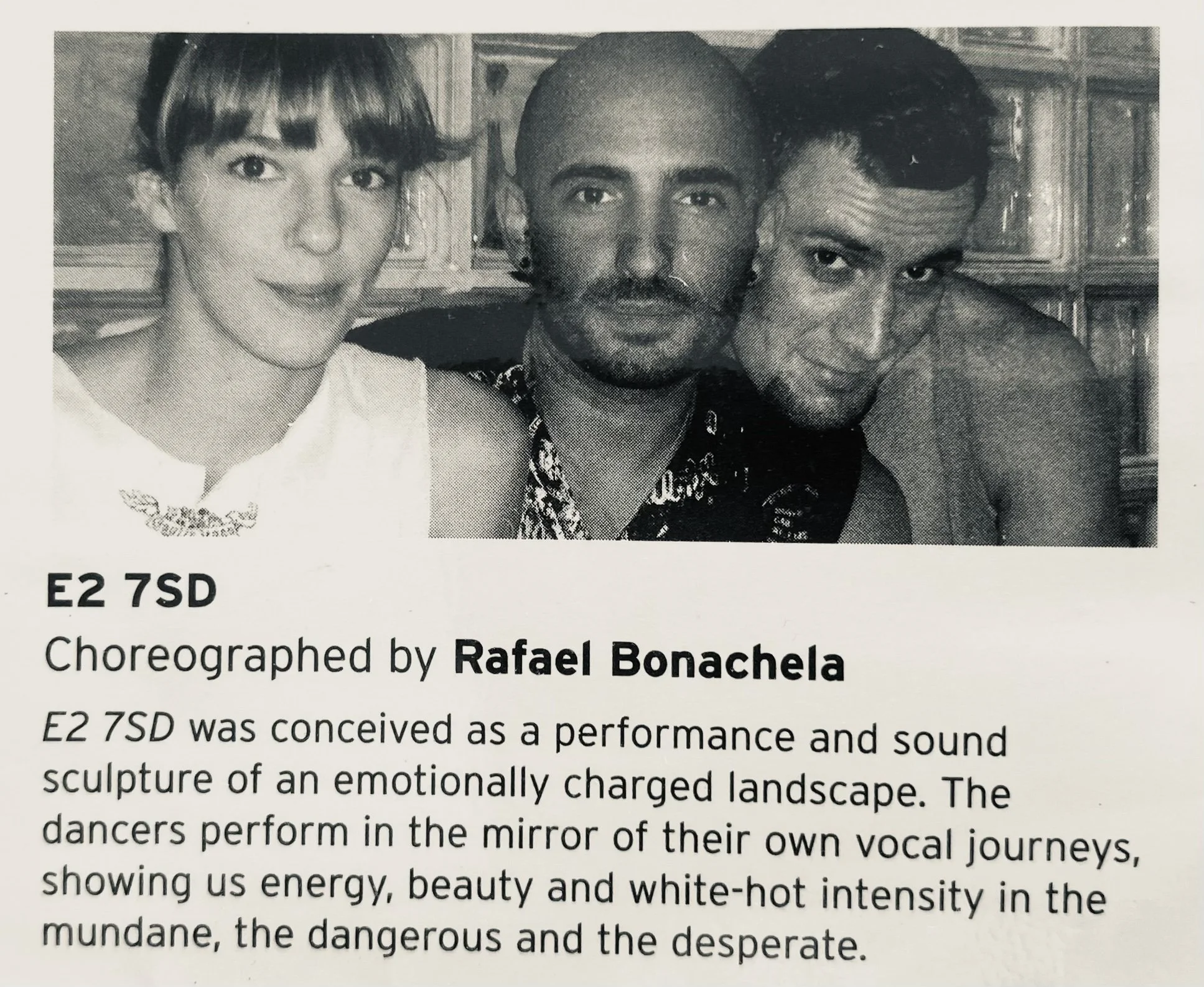
E2 7SD won The 2004 Place Prize for Choreography, the Audience Vote Award and the New York Bloomberg Choice Award.
It is currently being performed by Sydney Dance Company.
